Protecting Students from Cyber Crime and Fraud: The University Student Guide
As thousands of students prepare to start or return to university this autumn, fraudsters and cyber criminals will be looking for opportunities to exploit the excitement and uncertainty that often comes with a new term.
Moving to a new city, arranging accommodation, managing finances and building new social networks can create opportunities for criminals to target students. Whether you’re a student, parent, guardian, friend or family member, understanding the risks can help prevent cyber crime and fraud.
Criminals use a wide range of tactics to steal your money or obtain personal information that can be used later in a fraud attempt. They operate on websites and apps, by email, text, phone, post or in person, including on your doorstep.
Students are also frequently targeted through phishing emails, text messages and social media messages. These communications may appear to come from trusted organisations such as universities, banks, delivery companies or student finance providers. Their aim is to steal personal information, passwords or banking details.
What can anyone do to protect yourself or your offspring from cyber crime and fraud? These simple steps can make a big difference:
Be cautious of unexpected messages asking for personal or financial information.
Secure your accounts, especially your email and bank account.
Use passkeys over passwords wherever they are available. Where unavailable, use strong passwords, for example generated by a password manager and enable 2-step Verification (2SV).
Keep devices updated with the latest security and software updates.
Back up your important data and check your account recovery options.
Cyber crime and fraud can affect anyone, but awareness remains one of the strongest forms of protection. By recognising common tactics and talking openly about potential risks, we can help students enjoy a safe and successful university experience.
To support students and their families, Report Fraud has produced a practical guide packed with advice, real-world examples and simple steps that students can take to protect themselves online and offline throughout university life.
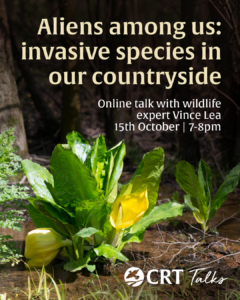
Aliens Among Us: Invasive Species in Our Countryside
The Countryside Regeneration Trust’s popular programme of free online talks returns on Thursday, October 15, from 7pm to 8pm, with a fascinating look at invasive species and their impact on our countryside
Around 2,000 Invasive Non-Native Species (INNS) are known in the UK, with more arriving each year, mainly accidentally through international trade routes. Their economic impact has been estimated at around £4bn annually, through impacts on agriculture and fisheries, forestry, construction and development. They also have major ecological impacts and, in some cases, pose extinction threats to our native species.
Dr Vince Lea, the CRT’s Conservation Officer at Lark Rise Farm, Barton, will explore the growing challenge posed by invasive non-native species (INNS). More than 2,000 of these species are now found in the UK, with new arrivals continuing to enter, often accidentally, through international trade routes.
These species cost the UK economy an estimated £4 billion each year, affecting agriculture, fisheries, forestry, construction and development. They can also have serious impacts on wildlife, in some cases threatening native species with extinction.
Vince will explain how the CRT is tackling these issues and how local people can help. He will also discuss successful efforts to control American mink, which have contributed to the return of water voles in some areas.
There will be an opportunity to ask questions at the end of the talk. A recording of the talk will be made available afterwards to those who have registered in advance for the talk.
Vince has a wealth of knowledge on all aspects of wildlife conservation and has played a key role as conservation officer at the CRT for many years. Having monitored the wildlife on our farms for so long, he has a great insight into the changing environment and its impact on local wildlife species.
Vince was part of the steering group which became the Waterlife Recovery Trust, a project that is leading the way in eradicating American mink from Britain and helping water voles to make a recovery.
In his spare time Vince has been volunteering with the Cambridge Conservation Volunteers, a group that has taken on invasive species in many different ways, from Himalayan balsam in the local Bourn Brook to rhododendron on Lundy Island, false acacia in Czechia and azalea on Scottish hillsides.